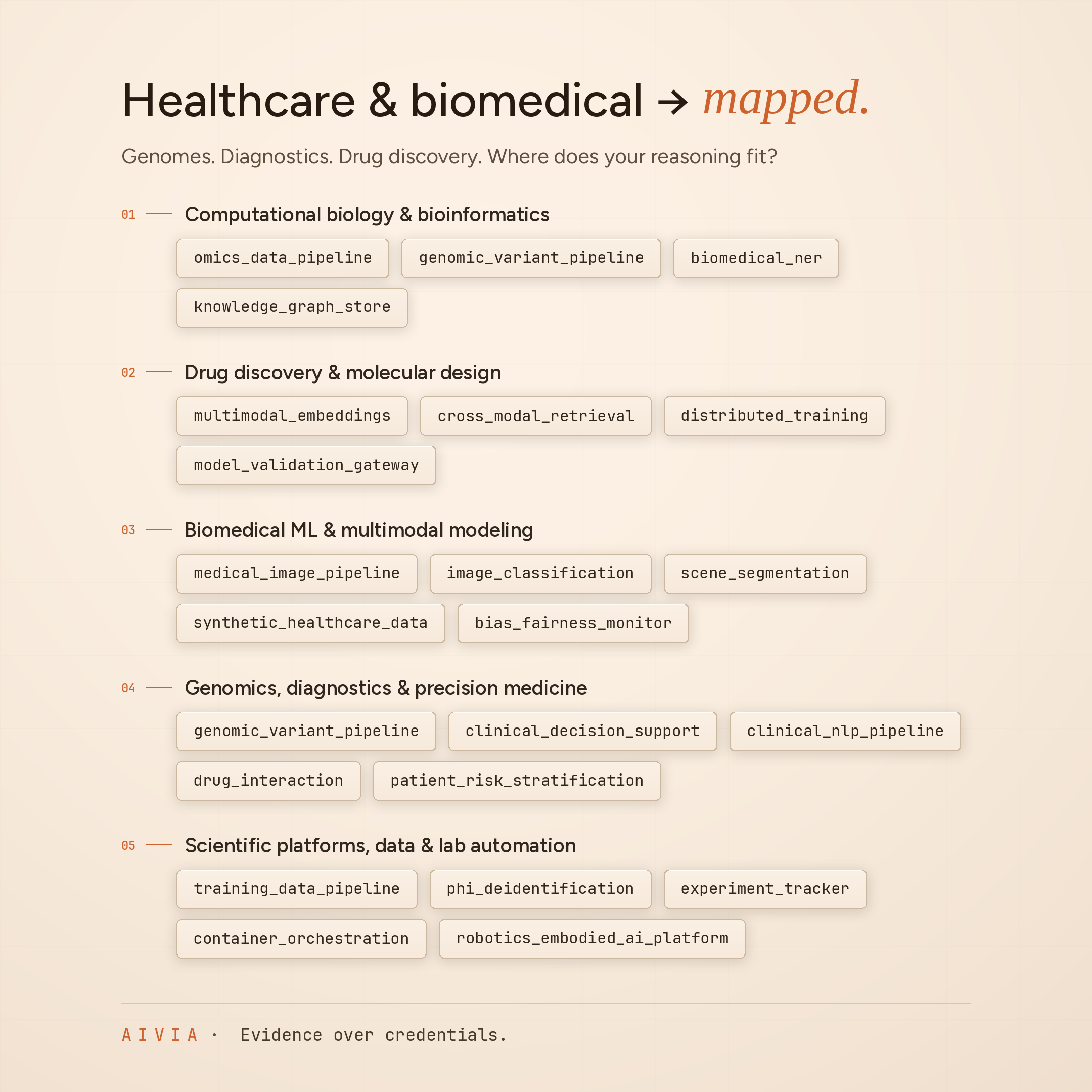
AIVIA Career Map: Healthcare & Biomedical AI
Healthcare and biomedical AI spans computational biology, bioinformatics, genomics, drug discovery, molecular design, biomedical machine learning, diagnostics, scientific software, data platforms, and laboratory automation. This map lays out those surfaces: what each involves, how the roles differ across them, and the openings that map to each.
Each component is an AIVIA evaluation unit, a system area where engineers and scientists make decisions, debug failures, and explain tradeoffs. All components are listed below; some have public evaluations now, with more added over time.
Candidates: Where an evaluation is live, you can take it for detailed feedback whether you are currently looking for open opportunities or not. It doubles as upskilling and interview prep, and you decide whether any result is visible.
Hiring teams: Use live evaluations to search and prescreen candidates, or work with us to create custom components and evaluations matched to your roles.
The job links are here to make the map concrete. They show how each technical surface appears in real hiring language, from computational biology and genomic interpretation through drug discovery, multimodal modeling, scientific software, and research infrastructure. Some roles appear under more than one family because the work genuinely spans several surfaces. A few postings may have moved or closed since this map was compiled in June 2026; where a specific role has closed, the linked company careers pages list current equivalents.
01 · Computational biology and bioinformatics
These roles use computational methods to study biological systems, disease mechanisms, genetic variation, and large-scale experimental data. Scientists and engineers reason about sequencing pipelines, statistical models, pathway analysis, biological networks, gene prioritization, and the limits of conclusions drawn from noisy or incomplete data.
The hard part is that biological data rarely behaves like a clean benchmark. A signal may reflect real biology, sequencing platform effects, batch structure, population representation, sample quality, or an assumption built into the analysis pipeline.
Example openings
Senior / Staff / Full-time
- Genentech — Principal Scientist, Bioinformatics Human Genetics
- Genentech — Postdoctoral Fellow, Computational Biology & Medicine (Jhunjhunwala Lab)
- Recursion — Associate Principal Computational Biologist, Neuroscience
- Genentech — Research Informatics jobs
- Recursion — Open positions
Components
- Omics data pipeline: Processes sequencing and molecular data from raw inputs through quality control, normalization, feature generation, and analysis-ready outputs. Batch effects, sample swaps, platform drift, and silent preprocessing changes can alter downstream biological conclusions.
- Genomic variant interpretation pipeline: Combines variant calls, annotations, reference databases, evidence rules, and expert review into clinically meaningful classifications. The hard part is keeping evidence traceable while accounting for transcript choice, population representation, review status, and uncertainty.
- Biomedical NER & entity linking: Extracts genes, proteins, diseases, variants, drugs, and other biomedical concepts from unstructured text and links them to normalized identifiers (SNOMED, ICD, UMLS). Ambiguous names and changing vocabularies can quietly connect evidence to the wrong entity.
- Knowledge graph store: Represents biological entities and relationships for pathway analysis, target discovery, and multi-hop reasoning. The challenge is maintaining provenance and preventing uncertain or outdated relationships from looking authoritative.
- Dataset registry: Tracks biological datasets, versions, consent constraints, provenance, and approved uses. Without reliable lineage, teams may compare incompatible cohorts or train on data that cannot support the intended claim.
- Data quality checker: Detects missingness, schema changes, sample anomalies, distribution shifts, and integrity issues before downstream analysis. Aggregate checks can still miss failures concentrated in one platform, tissue, ancestry group, or disease subtype.
02 · AI for drug discovery and molecular design
These roles apply machine learning, computational chemistry, simulation, and generative modeling to therapeutic target identification, molecular screening, protein design, and drug development.
Engineers and scientists reason about biological representations, molecular structures, training objectives, simulation assumptions, model confidence, experimental validation, and whether an apparent computational improvement is likely to translate into useful laboratory evidence.
The hard part is that a model can optimize a proxy while failing the actual scientific goal. A molecule may score well computationally yet be unstable, difficult to synthesize, biologically inactive, or unsafe.
Example openings
Senior / Staff / Full-time
- Isomorphic Labs — Research Scientist (Machine Learning), London
- Isomorphic Labs — Computational Drug Designer, London / Lausanne
- Isomorphic Labs — Head of Computational Drug Design, Cambridge MA
- Recursion — Senior Computational Biologist, Target ID
- Recursion — Engineering Manager, Machine Learning
- Genentech — Data Science & AI/ML jobs
Components
- Omics data pipeline: Produces biological features used for target identification, disease modeling, and patient stratification. If preprocessing changes alter the signal, downstream target-ranking models may appear more confident without becoming more biologically correct.
- Knowledge graph store: Connects genes, proteins, pathways, diseases, compounds, and experimental findings for target and mechanism reasoning. Correlated or circular evidence can make a weak target look independently supported.
- Multimodal embedding service: Generates shared embeddings across molecular structures, sequences, images, assays, text, and omics measurements. A representation can align modalities numerically while collapsing distinctions that matter biologically.
- Cross-modal retrieval: Finds related molecules, proteins, phenotypes, publications, or experiments across different data types. Similarity is useful only when the retrieved evidence is relevant to the scientific question being asked.
- Distributed training orchestrator: Coordinates training of large biological or molecular models across multiple accelerators and nodes, handling parallelism, gradient synchronization, and fault recovery. Reproducibility, numerical stability, communication overhead, and data-partition assumptions become part of the scientific result.
- Model validation gateway: Prevents a model from progressing until it passes predefined checks for performance, robustness, calibration, provenance, and intended-use constraints. The gate must catch scientific invalidity, not just software failure.
03 · Biomedical ML and multimodal modeling
These roles combine imaging, pathology, clinical records, molecular measurements, omics data, and longitudinal outcomes to model disease, predict phenotypes, or support research and clinical decisions.
Engineers reason about representation learning, modality alignment, missing data, label quality, subgroup performance, calibration, and whether a model is learning the intended biological signal or an easier shortcut.
The hard part is that multimodal systems can appear stronger simply because one modality dominates. A model may perform well overall while failing when an image is missing, a hospital workflow changes, or a patient subgroup is underrepresented.
Example openings
Senior / Staff / Full-time
- Tempus — Staff Machine Learning Scientist (multimodal models, oncology)
- Insitro — Senior Machine Learning Scientist, Imaging
- Genentech — Data Science jobs
- Recursion — Open positions
Components
- Medical image analysis pipeline: Ingests, standardizes, segments, and analyzes medical or biological images for downstream modeling. Scanner differences, acquisition protocols, preprocessing, and annotation quality can produce apparent disease signals that do not generalize.
- Multimodal embedding service: Serves a shared representation across images, clinical text, molecular measurements, and other modalities. The challenge is preserving modality-specific information while still learning useful cross-modal structure.
- Cross-modal retrieval: Retrieves related cases, images, reports, samples, or molecular profiles across modalities. A clinically similar case may still be inappropriate evidence if the cohort, disease stage, or acquisition context differs.
- Image classification serving: Serves biomedical or clinical image classification models with input validation, batching, and calibration at scale. Shortcut features, label leakage, site effects, and class imbalance can produce high validation scores without reliable deployment behavior.
- Scene segmentation: Assigns pixel- or region-level labels to cells, tissues, lesions, organs, or structures. Boundary ambiguity and annotation inconsistency often matter more than aggregate overlap metrics reveal.
- Synthetic healthcare data generator: Creates realistic, privacy-preserving synthetic patient data for model development and testing, preserving statistical fidelity and temporal dependencies. The challenge is producing data faithful enough to be useful without leaking real patients or encoding artifacts that models then exploit.
- Model performance monitor: Tracks model accuracy, calibration, drift, latency, and subgroup behavior after deployment. The work is identifying whether a change reflects real population movement, workflow change, acquisition drift, or model degradation.
- Bias & fairness monitor: Measures performance differences across demographic, clinical, biological, and operational subgroups, with thresholds tied to regulatory and policy requirements. A fairness metric is only useful when the subgroup definitions and missing-data patterns support the comparison.
- Annotation & labeling pipeline: Coordinates expert review, adjudication, label provenance, versioning, and dataset updates across modalities. Biomedical labels are often uncertain, evolving, and dependent on the evidence available at the time.
04 · Genomics, diagnostics, and precision medicine
These roles turn genomic, molecular, and clinical data into diagnostic evidence, patient stratification, biomarker insights, and treatment recommendations.
Engineers and scientists reason about variant calling, pathogenicity evidence, clinical terminology, patient context, regulatory traceability, subgroup performance, and how uncertainty should be communicated to clinicians and patients.
The hard part is that technically valid output can still be clinically misleading. A classification may use stale evidence, a recommendation may ignore longitudinal context, or a model may perform differently across variant classes, ancestry groups, disease stages, or sequencing platforms.
Example openings
Senior / Staff / Full-time
- 10x Genomics — Sr. Scientist, Clinical Bioinformatics
- 10x Genomics — Scientist II, Clinical Bioinformatics
- Foundation Medicine — Research and Development teams
- Foundation Medicine — Current openings
- 10x Genomics — Careers
Components
- Genomic variant interpretation pipeline: Converts variant calls and external evidence into classifications and reportable interpretations. Platform drift, variant-class calibration, mosaic signals, transcript choice, fabricated citations, and evidence dependence can all produce plausible but unsupported conclusions.
- Clinical decision support engine: Surfaces recommendations, warnings, or explanations inside clinical workflows. The system must account for patient context, longitudinal history, timing, clinician workload, and the consequences of both missed and excessive alerts.
- Clinical NLP pipeline: Extracts diagnoses, symptoms, medications, procedures, and clinical events from notes and reports. Ambiguous language, copied text, negation, and changes in documentation practice can distort the patient state.
- Biomedical NER & entity linking: Maps clinical and biomedical mentions to standardized concepts (SNOMED, ICD, UMLS). Linking the wrong gene, disease, drug, or variant can corrupt every downstream rule and retrieval step.
- Drug interaction knowledge system: Maintains a knowledge graph of drug–drug interactions with real-time checking and severity classification. The hard part is keeping interaction evidence current and context-aware, so alerts reflect the patient’s actual medication list, dosing, and comorbidities rather than firing on every theoretical pair.
- Medication safety system: Monitors prescribing patterns, validates dosages against patient context, and detects adverse drug events from clinical data with real-time alerting. Alert thresholds determine whether the system catches genuine harm or buries clinicians in noise they learn to ignore.
- Patient risk stratification: Estimates patient risk or prioritizes follow-up using clinical, genomic, and operational data. Calibration, subgroup performance, intervention availability, and changing care pathways determine whether a score is useful.
- EHR/FHIR integration layer: Exchanges structured clinical data across systems using healthcare interoperability standards. Mapping errors, stale records, missing fields, and conflicting identifiers can make downstream models reason from an incomplete patient picture.
- FDA-compliant audit trail: Records model versions, evidence sources, user actions, overrides, and decision history for regulated workflows. The audit trail must preserve enough context to reconstruct why an output was produced.
- Clinical trial matching engine: Matches patients to trial eligibility criteria from clinical records, genomic evidence, and protocol text. The challenge is handling temporal criteria, missing data, ambiguous exclusions, and rapidly changing trial status.
05 · Scientific platforms, data, and lab automation
These roles build the software, data, compute, and automation infrastructure that makes modern biological research reproducible and scalable.
Engineers reason about workflow orchestration, data lineage, experiment tracking, scientific interfaces, cloud infrastructure, laboratory devices, model deployment, and how to preserve reproducibility while research requirements change quickly.
The hard part is that a platform can be technically reliable while producing scientifically irreproducible work. A pipeline may run successfully with the wrong dataset version, hidden parameter changes, incomplete metadata, or a device calibration problem.
Example openings
Senior / Staff / Full-time
- Genentech — Senior Scientific Software Engineer, Analytics and Workflows
- 10x Genomics — Senior Data Platform Engineer
- 10x Genomics — Careers
- Recursion — Open positions
Components
- Omics data pipeline: Automates ingestion, quality control, transformation, and analysis of sequencing and molecular data. Scientific reproducibility depends on preserving versions, parameters, reference files, and sample provenance.
- Dataset registry: Catalogs datasets, versions, metadata, access restrictions, and intended uses. It prevents teams from silently training or comparing models on incompatible data.
- Training data pipeline: Builds model-ready datasets through filtering, joining, labeling, splitting, and feature generation. Leakage, duplicate subjects, and changing inclusion criteria can invalidate evaluation.
- Multi-modal data storage: Stores, indexes, retrieves, and versions large-scale multi-modal datasets — images, sequences, assay outputs, documents, metadata, and derived features — while preserving the relationships among them. Poor linkage makes it difficult to reconstruct which evidence supported a result.
- PHI de-identification service: Removes protected health information from clinical data so it can support HIPAA-compliant ML training and research. The hard part is that de-identification can fail silently — re-identification risk hides in free text, rare diagnoses, dates, and quasi-identifiers that look harmless in isolation.
- Synthetic healthcare data generator: Generates realistic, privacy-preserving synthetic patient data for model development, testing, and sharing, maintaining statistical fidelity and temporal dependencies. The risk is data that is either too close to real patients to be safe or too smoothed to reflect the biology it is meant to stand in for.
- Notebook platform: Provides managed computational environments for exploratory research and analysis. Reproducibility, package drift, resource isolation, and the transition from notebook to production workflow are the recurring challenges.
- Experiment tracker: Records datasets, parameters, code versions, metrics, artifacts, and model outputs across experiments. In scientific work, tracking must include enough biological and analytical context to reproduce the conclusion.
- Container orchestration for ML: Manages containerized training and serving workloads on shared infrastructure with GPU scheduling, scaling, and resource quotas. Resource contention, hardware variation, and environment mismatch can change both runtime and numerical behavior.
- Enterprise data pipeline platform: Supports reliable ingestion, transformation, validation, and delivery of research and operational data at scale. Schema evolution and partial failures can propagate silently into many downstream analyses.
- Event-driven orchestration: Coordinates workflows in response to experiment completion, instrument output, data arrival, or review events. Duplicate events and out-of-order execution can lead to repeated or inconsistent scientific processing.
- Robotics & embodied AI platform: Coordinates perception, world modeling, planning, control, execution, and safety validation for automated physical systems. In laboratory settings, this is the closest existing component to autonomous experimentation and lab automation.
Internships and early-career
Healthcare and biomedical AI roles often appear as internships, research internships, fellowships, postdoctoral positions, associate scientist roles, bioinformatics analyst roles, and early-career software or machine-learning positions inside larger research teams.
Early-career work may involve dataset curation, assay analysis, genomic pipelines, literature evidence review, image annotation, model evaluation, workflow tooling, or research data infrastructure before the individual owns an entire scientific system.
The important signal is not whether the title contains “AI.” It is whether the work touches biological data, computational modeling, genomics, diagnostics, scientific software, research infrastructure, or evidence-based decision-making.
Example openings
Internships & Early-Career
- Insitro — Machine Learning Intern, Summer 2026
- Recursion — Internship (general)
- Genentech — Postdoctoral Fellow, Computational Biology & Medicine (Jhunjhunwala Lab)
- 10x Genomics — Careers
- Recursion — Open positions
- Foundation Medicine — Current openings
Evaluations
The first evaluations for this area are landing around genomic interpretation, clinical decision support, biomedical evidence, healthcare data, and technical decision-making. Follow these categories to see what is open and catch new ones as they are added:
Healthcare & biomedical
Technical decision-making
Candidates: Get started today and start building your profile. AIVIA evaluations sharpen skills, double as interview prep, and give you detailed feedback every time. Results stay private by default unless you choose to share them.
Hiring teams: Start with the live evaluations. Prescreen with custom ones. Search the talent pool by verified reasoning.
Instructors: AIVIA can also be adapted for courses and student cohorts. We can tailor components, evaluations, feedback, and scheduling around your subject area and learning objectives.
New here? Start with the quick start.
Questions? Reply below.