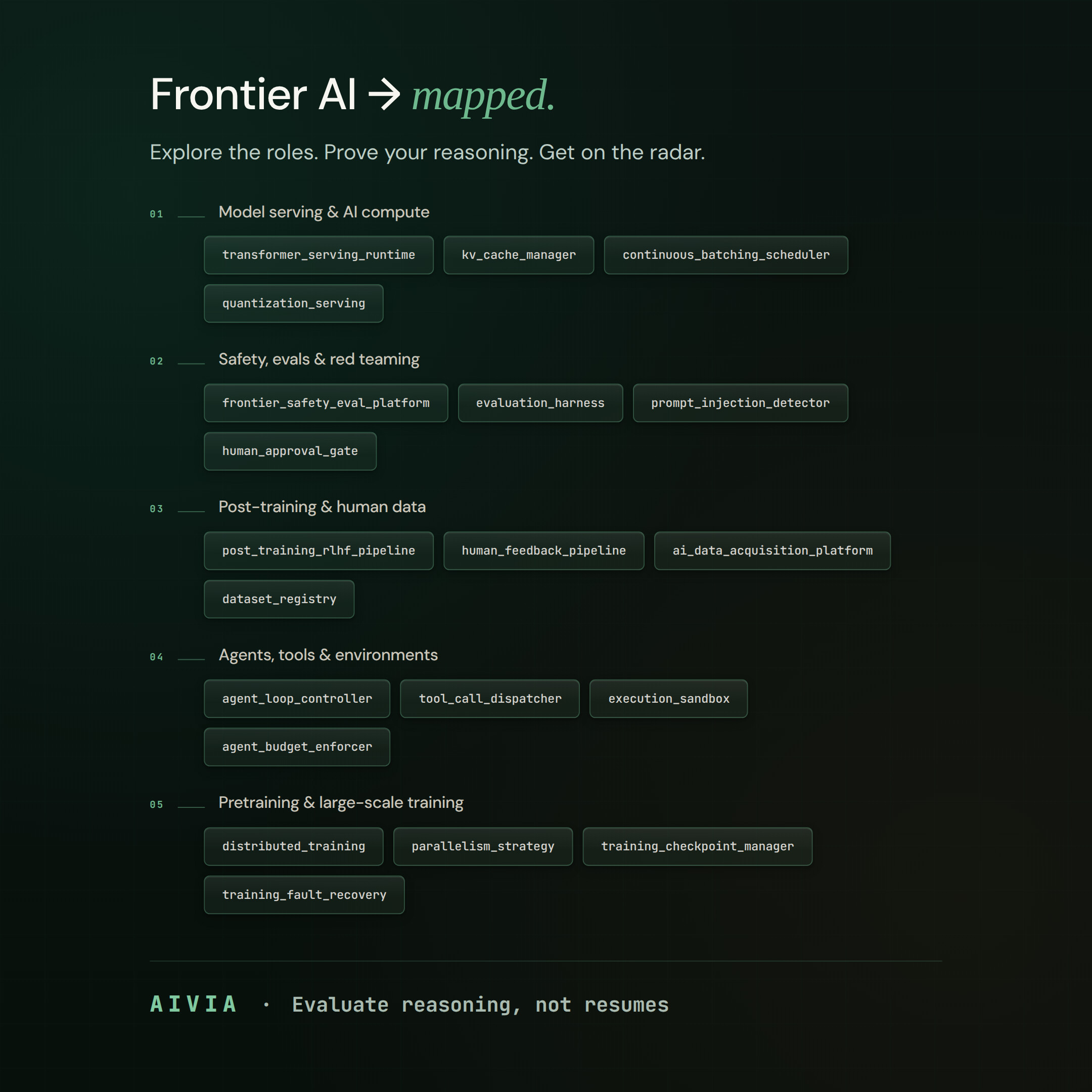
AIVIA Career Map: Frontier AI Engineering
Frontier AI engineering spans model serving, inference infrastructure, post-training, human data, safety evaluation, applied AI deployment, agents, tools, multimodal product systems, and pretraining at scale. This map lays out those surfaces: what each involves, how the roles differ across them, and the openings that map to each.
Each component is an AIVIA evaluation unit, a system area where engineers make decisions, debug failures, and explain tradeoffs. All components are listed below; some have public evaluations now, with more added over time.
Candidates: Where an evaluation is live, you can take it for detailed feedback whether you are currently looking for open opportunities or not. It doubles as upskilling and interview prep, and you decide whether any result is visible.
Hiring teams: Use live evaluations to search and prescreen candidates, or work with us to create custom components and evaluations matched to your roles.
The job links are here to make the map concrete. They show how each technical surface appears in real hiring language, from applied AI and product deployment through infrastructure, safety, post-training, agents, multimodal systems, and pretraining. A few postings may have moved or closed since this map was compiled in June 2026.
Jump to a role family
- 01 · Model serving, inference, and AI compute infrastructure
- 02 · Safety, safeguards, model evaluation, and red teaming
- 03 · Post-training, human data, and model behavior
- 04 · Agents, tools, environments, and research tooling
- 05 · Multimodal and real-time AI product systems
- 06 · Applied AI deployment and customer systems
- 07 · Pretraining infrastructure and large-scale training systems
- Internships and early-career (across roles)
01 · Model serving, inference, and AI compute infrastructure
These roles cover the path from a trained model to fast, reliable, cost-aware serving. Engineers reason about GPU memory, batching, KV cache behavior, model routing, latency tail behavior, and large accelerator fleets.
The model is only ever experienced through the serving layer. A single decision, such as KV cache eviction policy, batch composition, or quantization variant, can shift cost, p99 latency, output quality, and reliability at the same time.
Example openings
Senior / Staff / Full-time
- Anthropic — Performance Engineer, Inference Systems
- Anthropic — Senior Software Engineer, Inference
- Cohere — Site Reliability Engineer, Inference Infrastructure
- OpenAI — Software Engineer, Model Inference
- OpenAI — Software Engineer, GPU Infrastructure - HPC
- xAI — Member of Technical Staff, Inference
Components
- Transformer Serving Runtime: The runtime that holds the model in GPU memory and streams tokens back to users. Tensor and pipeline sharding, memory accounting, and the long tail of multi-tenant requests that don’t fit the expected shape.
- KV Cache Manager: Managing the attention cache across thousands of concurrent tokens. Prefix sharing, eviction policy, and avoiding the out-of-memory failure mid-generation when the cache grows past what was budgeted.
- Continuous Batching Scheduler: Grouping inference requests into dynamic batches to keep accelerators saturated. The tail-latency penalty when a single long-generation request blocks everything else in its batch.
- Model Router: Routing each request to the right model deployment based on task, cost, latency budget, and cluster health. Falling back to a smaller model when the big one is slow, without breaking quality.
- Quantization Serving: Serving compressed model variants alongside full-precision ones and routing between them. The accuracy regressions that show up only on rare inputs.
- Accelerator Kernel Optimization: Writing performant code for GPU and TPU kernels, including fused attention, collective communication, and custom paths for hot workloads.
- AI Compute Fleet Orchestration: Running large accelerator fleets across scheduling, capacity, and reliability. When a node fails mid-job, the work is making the loss invisible to users.
02 · Safety, safeguards, model evaluation, and red teaming
These roles focus on measuring whether frontier models behave safely and reliably. Engineers reason about eval design, adversarial testing, red-team workflows, misuse risk, regression tracking, and the safety evidence that goes into release decisions.
The hard part isn’t asking whether a model passed a benchmark. The hard part is knowing whether the benchmark actually tests the risk you care about, and whether the next training run quietly contaminated the eval set you’ve been trusting.
Example openings
Senior / Staff / Full-time
- Anthropic — Research Engineer, Model Evaluations
- Anthropic — Research Engineer / Scientist, Frontier Red Team, Cyber
- Cohere — Senior Research Engineer, Model Evaluation
- Mistral — Applied AI, Evaluation Engineer
- OpenAI — Research Engineer, Frontier Evals & Environments
- OpenAI — Software Engineer, AI Safety
Components
- Frontier Safety Eval Platform: The platform that runs adversarial safety, autonomy, misuse, and capability evaluations against frontier models. Building the evals that catch the failures benchmarks miss.
- Evaluation Harness: Running automated evals against test suites and tracking how scores move version-to-version. Distinguishing real regressions from noise in small eval sets.
- Eval Dataset Manager: Storing and versioning eval datasets and golden answers, with the contamination-prevention work of knowing what entered training and when.
- Offline Eval Pipeline: Testing model and prompt changes against golden datasets before they reach users. Closing the gap between offline scores and what production actually sees.
- Prompt Injection Detector: Catching attempts to hijack the model’s instructions through user input, retrieved documents, or tool outputs. The cat-and-mouse problem of new injection patterns appearing in the wild.
- Human Approval Gate: The pause point where high-impact actions wait for human review. Deciding what’s high-impact, who reviews, and how to keep the queue from becoming a rubber stamp.
03 · Post-training, human data, and model behavior
These roles cover what happens after pretraining: preference data, reward models, policy optimization, human feedback, model behavior, and the data infrastructure behind every improvement loop.
A reward model trained on three thousand careful annotations can beat one trained on three hundred thousand sloppy ones. The work is figuring out what “careful” means for the behavior you want, then building a collection process that actually produces it, and catching the run that looks mathematically perfect on paper but sounds robotic or sycophantic to users.
Example openings
Senior / Staff / Full-time
- Anthropic — Software Engineer, Human Data Interface
- Anthropic — Software Engineer, Research Data Platform
- Cohere — Member of Technical Staff, Pre-Training Data
- OpenAI — Software Engineer, Data Acquisition
- OpenAI — Software Engineer, Research - Human Data
- Scale AI — Machine Learning Systems Research Engineer, Agent Post-training
- xAI — Member of Technical Staff, Post-Training and RL
Components
- Post-Training RLHF Pipeline: The full loop from preference data to reward model to policy optimization to evaluation. Reward hacking, distribution shift between SFT and RL, and the runs that look fine in metrics but worse to users.
- Human Data Collection Platform: The annotator-facing tools that collect demonstrations, preferences, and reviews. Annotator agreement, instruction drift, and the quality-control loops that catch lazy labels before they reach training.
- Human Feedback Pipeline: Aggregating human judgments on model outputs and turning them into a signal training can use. Inter-rater reliability, calibration, and the systematic biases that creep in over a long collection campaign.
- AI Data Acquisition Platform: Finding, filtering, rights-checking, and preparing the data that goes into training. Provenance, deduplication, and the long tail of judgment calls about what to include.
- Training Data Pipeline: Preparing and serving training data at scale: shuffling, augmentation, distributed loading, and the label-transform inconsistencies that quietly break runs.
- Dataset Registry: Versioning training and eval datasets with lineage, so a result months later can be traced back to the exact data that produced it.
04 · Agents, tools, environments, and research tooling
These roles focus on systems where models act through tools, run in environments, and complete multi-step tasks. Engineers reason about tool schemas, execution sandboxes, agent loops, failure boundaries, budgets, and the evaluation environments that test all of it.
Agentic systems make model behavior more powerful and harder to inspect. Because the loop runs multi-step tasks independently, a single tool-schema mismatch can compound silently over many steps, with significant budget spent before anyone notices it’s failing.
Example openings
Senior / Staff / Full-time
- Anthropic — Research Engineer, Environment Scaling
- Anthropic — Machine Learning Systems Engineer, Research Tools
- OpenAI — Software Engineer, Agent Infrastructure
- OpenAI — Simulation Environments Engineer
- Scale AI — Frontier Agents Engineer
- xAI — Member of Technical Staff, RL Infrastructure
Components
- Agent Eval Environment Platform: Building task environments and simulations to test agent behavior under realistic constraints. The gap between sandbox success and real-world reliability.
- Agent Loop Controller: The core loop: reason, call a tool, observe, repeat. The work is knowing when to stop, when to retry, and when to escalate.
- Tool Call Dispatcher: Sending tool calls to their endpoints with concurrency control, timeouts, and retries. The errors agents recover from cleanly versus the ones that compound.
- Tool Schema Registry: Versioning tool definitions so agents and models stay in sync. A schema drift here can silently degrade behavior for weeks.
- Tool Result Validator: Checking that tool outputs match expected shapes before the agent acts on them. A small guardrail with outsized impact when an upstream tool changes its response format.
- Execution Sandbox: Running agent tools in isolation with permissions and resource limits. Filesystem and network policy, escape boundaries, and what to do when an agent legitimately needs more.
- Agent Budget Enforcer: Enforcing per-run limits on tokens, tool calls, time, and cost. Cutting off a runaway loop before it spends $400 to fail.
05 · Multimodal and real-time AI product systems
These roles focus on AI products that work across text, audio, image, video, and real-time interaction. Engineers reason about streaming latency, modality alignment, multimodal retrieval, voice quality, device constraints, and product feedback loops.
Users now interact natively across voice, video, and text at once. The work is end-to-end streaming systems where chunks across modalities arrive aligned at sub-300ms response times, and where a user’s sudden interruption doesn’t leave the system in a half-state.
Example openings
Senior / Staff / Full-time
- Google DeepMind — Research Scientist, Gemini Vision
- OpenAI — Software Engineer, Real Time
- OpenAI — Software Engineer, Inference - Multi Modal
- xAI — Member of Technical Staff, Media
- xAI — Member of Technical Staff, Multimodal Understanding
- xAI — Member of Technical Staff, Voice Model
Components
- Realtime Multimodal Interaction Platform: The platform behind low-latency voice, audio, vision, and multimodal interactions. Streaming, modality switching, and graceful handling of mid-conversation interruptions.
- Vision-Language Serving: Serving models that take images and text together for visual Q&A, captioning, and OCR-adjacent tasks. Getting both inputs in without blowing up time-to-first-token.
- Text-to-Speech: Generating natural-sounding speech with voice selection and real-time streaming. Prosody, pronunciation of rare words, and the artifacts that appear at chunk boundaries.
- Multimodal Embeddings: Generating embeddings from text, image, audio, and video into one shared space. Alignment between modalities, and what to do when they disagree.
- Multimodal Retrieval Pipeline: Retrieving across text, image, audio, and video using a shared embedding space. Cross-modal ranking and the long tail where one modality is far more informative than another.
- On-Device AI Runtime: Running models locally under latency, memory, battery, and thermal limits. What to keep on-device, what to send to the cloud, and how to fall back gracefully.
06 · Applied AI deployment and customer systems
These roles sit between frontier models and real-world use cases. Engineers reason about customer data, retrieval, tools, APIs, evals, integration boundaries, security constraints, and what it takes to move a system from prototype to production.
The hard part isn’t the prompt. It’s turning an ambiguous business workflow into a system that handles the messy parts: PII in the source data, retrieval that doesn’t return the wrong customer’s record, prompt versioning that catches regressions before they reach users.
Example openings
Senior / Staff / Full-time
- Anthropic — Applied AI Architect, Applied AI
- Mistral — Applied AI, Forward Deployed Machine Learning Engineer
- OpenAI — AI Deployment Engineer, Startups
- OpenAI — Forward Deployed Software Engineer
- Scale AI — Frontier Agents Engineer
Components
- RAG Pipeline: Retrieving the right context and feeding it to an LLM for grounded answers. Chunking choices, embedding drift, and the failure mode where retrieval returns adjacent-but-wrong documents and the model uses them confidently.
- LLM Gateway Router: The auth, rate-limit, and routing layer in front of provider APIs. Multi-provider failover, cost-aware routing, and keeping latency consistent when one provider degrades mid-stream.
- Developer Platform & SDK: The APIs, SDKs, docs, and examples developers build against. The surface area is the product; bad ergonomics here block every team downstream.
- Prompt Versioning System: Treating prompts like production code: versioned, reviewed, A/B routed, rollback-able. Catching the case where a small wording tweak tanks quality on a long-tail use case.
07 · Pretraining infrastructure and large-scale training systems
These roles cover the systems that actually produce frontier models: coordinating thousands of accelerators, managing training state, detecting pathologies early, and recovering from inevitable hardware failures over multi-week runs.
Silent failures here cost millions in compute. A dataloader bottleneck nobody noticed for three days. A NaN appearing at step 80k. Gradient norms quietly growing over a week before divergence. The work is making these visible early, and diagnosing subtle hardware drift before a run fully diverges.
Example openings
Senior / Staff / Full-time
- Anthropic — Research Engineer, Pretraining
- Anthropic — Research Engineer, Pretraining Scaling
- Cohere — Member of Technical Staff, Pre-Training
- OpenAI — Software Engineer, Training Infrastructure
- xAI — Member of Technical Staff, Pre-Training
Components
- Distributed Training: Coordinating training across thousands of accelerators. Job placement, communication topology, and what happens when one node falls behind and starts blocking everyone else.
- Parallelism Strategy: Choosing how to split a model across hardware: tensor, pipeline, sequence, data, expert. The tradeoffs between memory, communication overhead, and bubble time.
- Training Checkpoint Manager: Saving and restoring training state at scale without halting the run. Frequency tradeoffs, async snapshot writes, and the partial-checkpoint corruption case nobody tests for until it happens.
- Training Loss Monitor: Watching loss, gradient norms, and activation statistics for early signs of pathology. Distinguishing a transient spike from the beginning of divergence.
- Training Data Loader: Feeding the training loop fast enough to keep accelerators saturated. Sharding, prefetching, and the silent throughput regression when a single bad shard slows the whole pipeline.
- Training Fault Recovery: Recovering from node failures, network partitions, and hardware errors mid-run. Resumption from the right checkpoint, replaying state, and getting back to throughput without manual intervention.
Parallelism Strategy, Training Checkpoint Manager, Training Loss Monitor, Training Data Loader, and Training Fault Recovery are queued as AIVIA evaluation units and added on demand.
Internships and early-career
Frontier labs hire most early-career talent through programs that span research and engineering rather than through team-specific intern postings, so they’re collected here rather than split across the families above. Seasonal internships open and close quickly, so check each lab’s board directly for current dates.
Programs (research and engineering, across the families above)
- OpenAI — Emerging Talent: internships and full-time roles for people roughly 0 to 3 years into their careers, including recent graduates.
- OpenAI — Residency: a six-month, fully salaried program for engineers and researchers moving into AI from an adjacent field.
- Anthropic — Fellows Program: a funded, mentored research fellowship for people entering AI safety research, with applications open to a broad range of backgrounds.
- Google DeepMind — Student Researcher Program: paid research, science, and engineering internships for enrolled BS, MS, and PhD students.
Internship openings
Evaluations
The first evaluations are landing in the areas hiring teams are asking about most:
Data & retrieval
Model serving
Agent orchestration
AI evaluation & observability
Technical decision-making
Follow those categories to see what’s open and catch new ones as they’re added.
Candidates: Get started today and start building your profile. AIVIA evaluations sharpen skills, doubles as interview prep, and gives you detailed feedback every time. Results stay private unless you choose to share them.
Hiring teams: Start with the live evaluations. Prescreen with custom ones. Search the talent pool by verified reasoning.
New here? Start with the quick start.
Questions? Reply below.