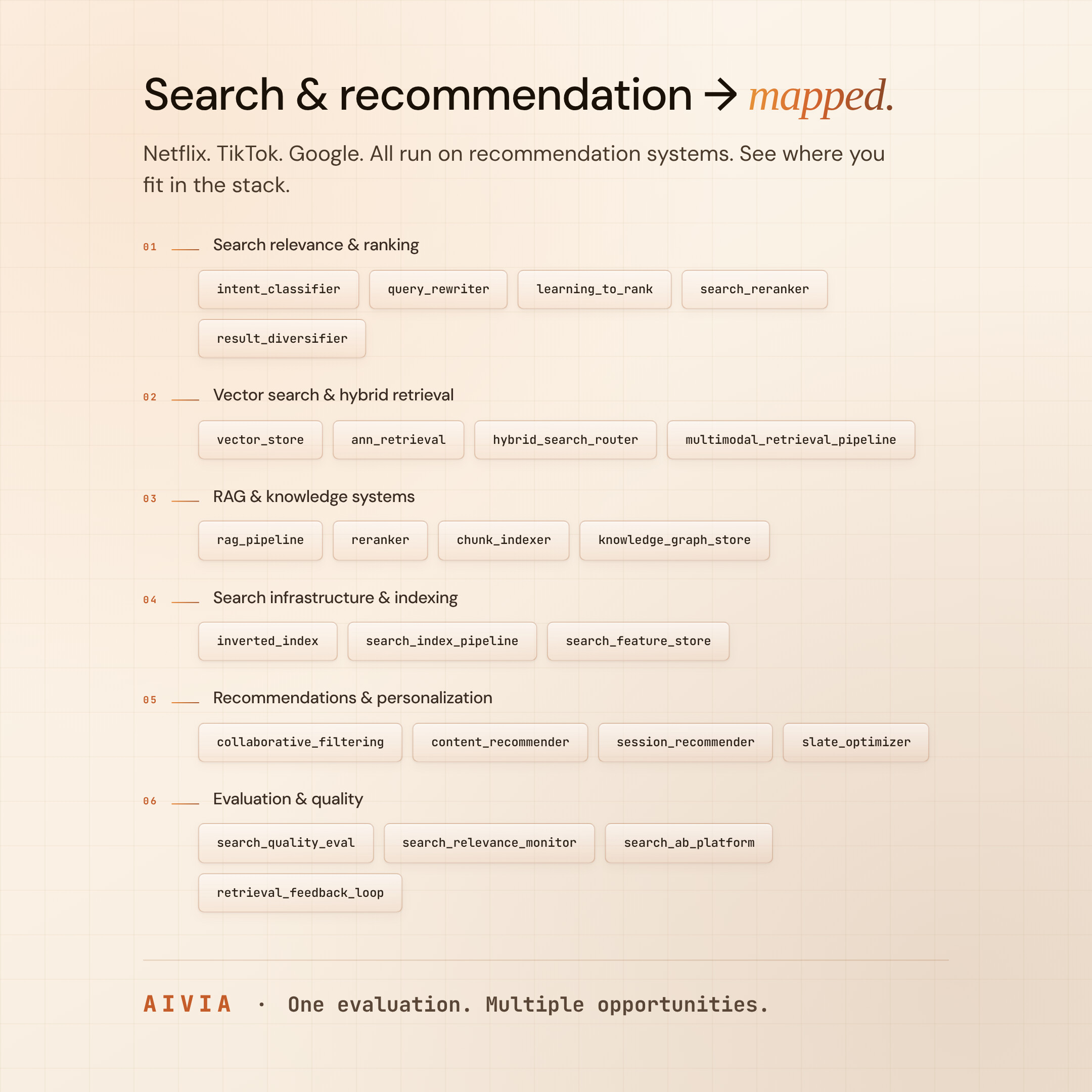
AIVIA Career Map: AI Search & Retrieval Engineering
AI search and retrieval engineering spans relevance, ranking, semantic search, vector databases, RAG systems, indexing, crawling, recommendations, personalization, evaluation, and observability. This map lays out those surfaces: what each involves, how the roles differ across them, and the openings that map to each.
Each component is an AIVIA evaluation unit, a system area where engineers make decisions, debug failures, and explain tradeoffs. All components are listed below; some have public evaluations now, with more added over time.
Candidates: Where an evaluation is live, you can take it for detailed feedback whether you are currently looking for open opportunities or not. It doubles as upskilling and interview prep, and you decide whether any result is visible.
Hiring teams: Use live evaluations to search and prescreen candidates, or work with us to create custom components and evaluations matched to your roles.
The job links are here to make the map concrete. They show how each technical surface appears in real hiring language, from search relevance and ranking through vector search, RAG, indexing, recommendations, quality systems, and early-career research paths. Some roles appear under more than one family, because the work genuinely spans several surfaces. A few postings may have moved or closed since this map was compiled in June 2026.
Jump to a role family
- 01 · Search relevance, ranking, and query understanding
- 02 · Vector search, embeddings, and hybrid retrieval
- 03 · RAG, knowledge systems, and enterprise search applications
- 04 · Search infrastructure, indexing, and scaling
- 05 · Recommendations, discovery, and personalization
- 06 · Search evaluation, observability, and quality systems
- Internships and early-career (across roles)
01 · Search relevance, ranking, and query understanding
These roles cover the work of deciding what result should appear first, why it should appear first, and how the system should interpret what a user actually meant. Engineers reason about query understanding, ranking signals, intent classification, relevance labels, reranking models, and the product cost of a wrong answer near the top.
The hard part is that relevance is rarely a single metric. A result can match the query, fail the user’s intent, overfit to popularity, miss a fresh document, or rank well offline while frustrating users in production.
Example openings
Senior / Staff / Full-time
- OpenAI — Research Engineer, Retrieval & Search, Applied Engineering
- Anthropic — Research Engineer, Knowledge Foundations
- Anthropic — Research Engineer, Knowledge Team
- Cohere — Member of Technical Staff, Search
- Google — Software Engineer III, Machine Learning, Search Intelligence
- Apple — AIML, Machine Learning Engineer, Retrieval and Ranking Quality, Siri Information Intelligence
- Apple — Machine Learning Engineer, Search & Knowledge Quality
Components
- Intent classifier: Classifies a query into intent categories and extracts slots so it routes to the right backend. The risk is a confident misclassification that sends the whole query down the wrong path.
- Semantic query parser: Parses a natural-language query into a structured intent with filters, constraints, and sort order. Complex or ambiguous phrasing is where the structure comes out wrong.
- Query rewriter: Cleans up the raw query by expanding abbreviations, fixing typos, and adding synonyms while preserving intent. The danger is a rewrite that quietly changes what the user meant.
- Query expansion: Broadens short or ambiguous queries with related terms to improve recall. Expand too far and precision collapses.
- Spell corrector: Corrects spelling while respecting domain vocabulary, brand names, and intentional non-standard spellings. Over-correcting a real term is as harmful as missing a typo.
- Entity tagger: Tags named entities in a query for structured filtering and entity-aware ranking. A missed or wrong entity changes which results are even eligible.
- Learning-to-rank: An ML model that scores and orders candidates on query, document, and user features as a second stage. The classic trap is gaining offline while losing online.
- Search reranker: Re-scores the top candidates with a cross-encoder or LLM for higher precision, inside a latency budget. The work is buying precision without blowing the budget.
- Result blender: Merges and deduplicates results from multiple backends into one ranking. Federating fairly across sources with different score scales is the hard part.
- Result diversifier: Re-orders results for topical or categorical diversity while keeping them relevant. Too much diversity buries the best answer; too little creates repetition.
02 · Vector search, embeddings, and hybrid retrieval
These roles cover semantic retrieval: turning documents, queries, images, products, or users into embeddings, indexing them, and retrieving nearest neighbors fast enough for production. Engineers reason about embedding quality, vector index design, hybrid search, approximate nearest neighbor tradeoffs, freshness, and recall under latency budgets.
The hard part is that vector search can look magical in demos and brittle in production. A semantically similar result can still be wrong. An index can be fast but miss important long-tail items. A new embedding model can improve benchmarks while breaking carefully tuned ranking behavior.
Example openings
Senior / Staff / Full-time
- Databricks — Staff Software Engineer, AI Search
- Elastic — Senior Software Engineer, Vector Search, Elasticsearch
- Elastic — Principal Software Engineer, Vector Search, Elasticsearch
- Cohere — Software Engineer, Search Applications
- Apple — Senior Machine Learning Engineer, Apple Search & Knowledge Platforms
- Apple — Staff Machine Learning Engineer, Search & Knowledge Platform
- Pinecone — Staff/Principal Software Engineer, Full Text Search
Components
- Vector store: Stores, indexes, and retrieves embeddings with approximate nearest-neighbor search for batch and real-time workloads. Index type, recall-latency tradeoffs, and what happens when the embedding distribution shifts.
- ANN retrieval: Runs approximate nearest-neighbor search over embeddings as a first-stage retriever. The system can pass basic tests while missing the rare queries that need a deeper search.
- Candidate generation service: Produces the initial candidate set from several retrieval strategies before ranking, balancing recall, latency, and diversity. Cut the pool too small and the best result never reaches the ranker.
- Hybrid search router: Combines dense vector and sparse keyword search and fuses the results. The work is weighting the two without letting one mode dominate by scale.
- Multimodal retrieval pipeline: Retrieves across text, image, audio, and video through a shared embedding space. Cross-modal matches can look similar yet be operationally wrong.
03 · RAG, knowledge systems, and enterprise search applications
These roles sit between search infrastructure and user-facing AI systems. Engineers reason about retrieving the right context, respecting permissions, grounding generation, compressing long documents, handling citations, and making enterprise knowledge usable without leaking sensitive data.
The hard part is that retrieval errors become model behavior. If the system retrieves an adjacent-but-wrong document, the model may produce a confident answer that looks grounded but is still false.
Example openings
Senior / Staff / Full-time
- OpenAI — Research Engineer, Retrieval & Search, Applied Engineering
- Anthropic — Research Engineer, Knowledge Foundations
- Anthropic — Research Engineer, Knowledge Team
- Cohere — Software Engineer, Search Applications
- Cohere — Software Engineer, Applied ML, UK Public Sector
- Glean — Machine Learning Engineer, Enterprise Brain
- Hebbia — Backend Engineer, Growth and Data
Components
- RAG pipeline: Retrieves documents and conditions an LLM’s output on them for grounded answers. Retrieval recall, citation behavior, context-window limits, and the failure mode where the model uses the wrong passage confidently.
- Reranker: A cross-encoder that re-scores retrieved candidates between retrieval and generation, inside a latency budget. Spend too little and the wrong passage stays on top; spend too much and latency suffers.
- Chunk indexer: Orchestrates embedding, enrichment, deduplication, and incremental updates from document chunks into a searchable index. Stale or duplicated chunks quietly corrupt retrieval.
- Document processor: Ingests heterogeneous formats, extracts text, and produces clean chunks for embedding and indexing. Parsing errors and metadata loss here surface as bad answers later.
- Knowledge graph store: Holds entities and relationships extracted from documents for structured traversal and multi-hop reasoning. The hard part is keeping the graph correct as sources change.
- Policy retrieval layer: Applies business rules, boosting, filtering, and permissions on top of algorithmic results. In enterprise search this is also where document-level access control has to hold.
04 · Search infrastructure, indexing, and scaling
These roles cover the infrastructure beneath search: indexing, storage, query execution, crawling, freshness, distributed systems, and the operational work of keeping retrieval fast and reliable at scale.
The hard part is that users only see search quality, but the root cause may be infrastructure: a delayed index, a slow shard, a bad rollout, a corrupted document transform, or a query path that works for the median case but fails on long-tail workloads.
Example openings
Senior / Staff / Full-time
- Databricks — Staff Software Engineer, AI Search
- Elastic — Principal Software Engineer, Search Scaling, Elasticsearch
- Elastic — Principal Software Engineer, Vector Search, Elasticsearch
- OpenAI — Software Engineer, Database Systems
- Cohere — Member of Technical Staff, MLE
- Apple — Senior Search Machine Learning Engineer
- Pinecone — Senior Software Engineer, Database Team
- Reddit — Senior Staff Machine Learning Engineer, Search Platform
Components
- Inverted index: The core sparse retriever, mapping terms to postings lists with BM25 scoring, phrase matching, and boolean filtering. Whether a missing result is a ranking problem or an indexing one often starts here.
- Search index pipeline: Ingests, transforms, and indexes documents with incremental updates and consistency. Freshness, backfills, partial failures, and schema changes all live here.
- Search feature store: Computes and serves ranking features with training and serving consistency under latency limits. A feature that drifts between training and serving silently degrades ranking.
05 · Recommendations, discovery, and personalization
These roles cover systems that help users discover what they did not explicitly search for: recommended content, products, creators, games, ads, videos, people, or documents. Engineers reason about candidate generation, ranking, personalization, exploration, feedback loops, and the difference between relevance and long-term user value.
The hard part is that recommendation systems can optimize what users click while degrading what they actually want. A model can overfit to popularity, reinforce stale behavior, suppress niche interests, or learn from missing exposure as if it were rejection.
Example openings
Senior / Staff / Full-time
- Google — Software Engineer, Generative AI, Search Ads Personalization
- Amazon — Sr. MLE, Prime Video Personalization and Discovery
- Netflix — Machine Learning Engineer L4, Consumer Inference
- Netflix — Data Scientist 5, Personalization Algorithms Performance
- Spotify — Senior Machine Learning Engineer, Personalization
- Pinterest — Machine Learning Engineer, Core Engineering
- Reddit — Senior Machine Learning Engineer, ML Ranking Platform
- Roblox — Principal/Senior Machine Learning Scientist, Search and Discovery
Components
- Collaborative filtering: Recommends items from user-item interaction patterns, predicting preferences from what similar users liked. Popularity bias and sparse interactions are the usual traps.
- Content recommender: Recommends items by feature similarity to what a user has already engaged with. It can over-narrow into a loop that never surfaces anything new.
- Session recommender: Generates within-session recommendations for anonymous or new users from their browsing sequence. The signal is short and noisy.
- Cold-start handler: Bootstraps recommendations for new users or items through fallbacks, content features, and exploration. Treating absence of data as a negative signal is the failure to avoid.
- Exploration-exploitation: Balances confident picks against trying uncertain items to learn preferences. Too little exploration freezes the catalog; too much spends user trust.
- Personalization profile store: Builds, stores, and serves user preference profiles from behavioral signals for real-time personalization across surfaces. Stale or leaky profiles degrade every downstream surface.
- Slate optimizer: Optimizes the whole recommendation set for item interactions, diversity, and position effects rather than per-item relevance. The best individual items can still make a poor slate.
- Recommendation feedback collector: Captures implicit and explicit feedback and feeds it back into training and evaluation. Without exposure awareness, an item users never saw looks rejected.
- Ads monetization platform: Ranks, prices, and serves ads while balancing user relevance, advertiser budgets, policy, and revenue. The tension is monetization against the user experience.
06 · Search evaluation, observability, and quality systems
These roles focus on proving whether search is getting better. Engineers reason about offline evals, online experiments, query slices, human labels, ranking regressions, dashboards, alerts, and the tooling needed to explain quality changes.
The hard part is that aggregate metrics hide the failures users remember. A launch can improve average relevance while breaking medical queries, rare languages, long-tail documents, new content, or permission-sensitive enterprise searches.
Example openings
Senior / Staff / Full-time
- Anthropic — Research Engineer, Knowledge Foundations
- Anthropic — Research Engineer, Knowledge Team
- OpenAI — Research Engineer, Retrieval & Search, Applied Engineering
- Apple — Machine Learning Engineer, Search & Knowledge Quality
- Google — Software Engineer III, Machine Learning, Search Intelligence
- Glean — Machine Learning Engineer, LLM Evals + Observability
Components
- Search quality eval: Measures relevance through automated metrics, human judgments, and user-behavior analysis. The work is separating real quality movement from noise, label drift, and benchmark overfitting.
- Search relevance monitor: Watches live search quality and alerts on degradation across query segments. Slice-aware monitoring catches the regressions that averages hide.
- Search A/B platform: Runs controlled search experiments with traffic splitting, metrics, and statistical analysis. The hard part is reading small, noisy effects without fooling yourself.
- Retrieval feedback loop: Uses clicks, relevance judgments, or model self-critique to improve retrieval over time through online learning and embedding updates. The danger is a loop that reinforces its own past behavior.
Internships and early-career
Search and retrieval roles often appear as internships, PhD research internships, new-grad software roles, or applied ML roles inside larger product teams. Early-career engineers may work on candidate generation, eval datasets, embedding experiments, ranking features, query analysis, or production data pipelines before owning an entire retrieval system.
The important signal is not whether a role says “search” in the title. It is whether the work touches ranking, retrieval, recommendations, indexing, query understanding, user behavior, or evaluation.
Example openings
Internships & Early-Career
- Roblox — Machine Learning Engineer, Recommendation Systems, PhD Intern
- Netflix — Machine Learning / AI Scientist Intern, PhD, 2026
- Netflix — Machine Learning Engineer Intern, MS/PhD, 2026
- Amazon — Applied Science Internship, Recommender Systems / Information Retrieval / Machine Learning
- Pinterest — Master’s University Grad Machine Learning Engineer 2026 (USA)
- Glean — Software Engineer, Intern (Summer 2026)
Evaluations
The first evaluations for this area are landing around retrieval, ranking, RAG, recommendations, and search quality. Follow these categories to see what’s open and catch new ones as they’re added:
Data & retrieval
Recommendation engine
AI evaluation & observability
Technical decision-making
Candidates: Get started today and start building your profile. AIVIA evaluations sharpen skills, doubles as interview prep, and gives you detailed feedback every time. Results stay private unless you choose to share them.
Hiring teams: Start with the live evaluations. Prescreen with custom ones. Search the talent pool by verified reasoning.
New here? Start with the quick start.
Questions? Reply below.